
1
9
[PROJECT] How Combat Works
Combat is automatic and takes place on a grid. You prepare your character, the AI controls their movement, targeting and skill use.
Your choices matter: skills, their priority, roll variants, equipment and Reactive determine what your character can do.
Turns and movement
Combat is divided into rounds. Normally, each living character takes one turn per round, with higher Agility acting first. Heroes act before enemies when Agility is tied. Some bosses can take additional turns.
During a turn, a character can move and use one skill. Movement may happen before or after the skill, using one movement allowance.
Move 3 means up to three steps. Each step goes up, down, left or right. Characters cannot walk through allies, enemies or obstacles.
Reading the example
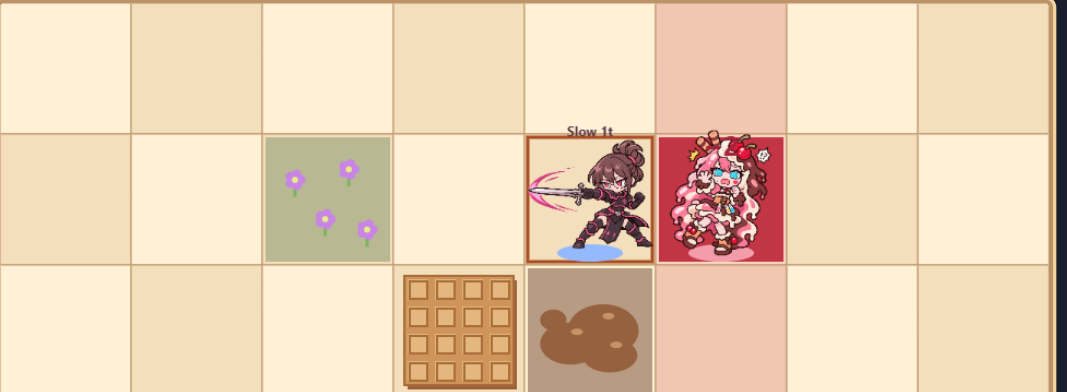
In the picture, Alice is standing directly beside Ilya. They are one tile apart, so Alice can use a skill that targets an adjacent enemy.
The coloured tiles show the area being highlighted for the selected attack. A highlighted tile does not guarantee damage: an enemy must be affected by the skill, and the attack may still be evaded.
Range and Area are different Range tells you where the main target can be. Area tells you which additional tiles the skill affects.
For an offensive skill, an enemy must occupy the main target tile. The AI cannot aim at an empty tile just to catch enemies in the additional area.
The AI tries to use the highest-priority skill that has a valid use. It looks for a reachable position and selects targets for that skill.
Priority comes first: a lower-priority area attack is not automatically chosen just because it could hit more enemies.
The AI also tries to avoid using the same skill twice consecutively when another valid option exists. Repetition is allowed when necessary. It skips an already-active self-buff rather than repeatedly refreshing it.
What the roll means If a skill has a selected range of 5–8, its base value is randomly rolled from:
5, 6, 7 or 8